D&PS – D&PS July 2025 Column
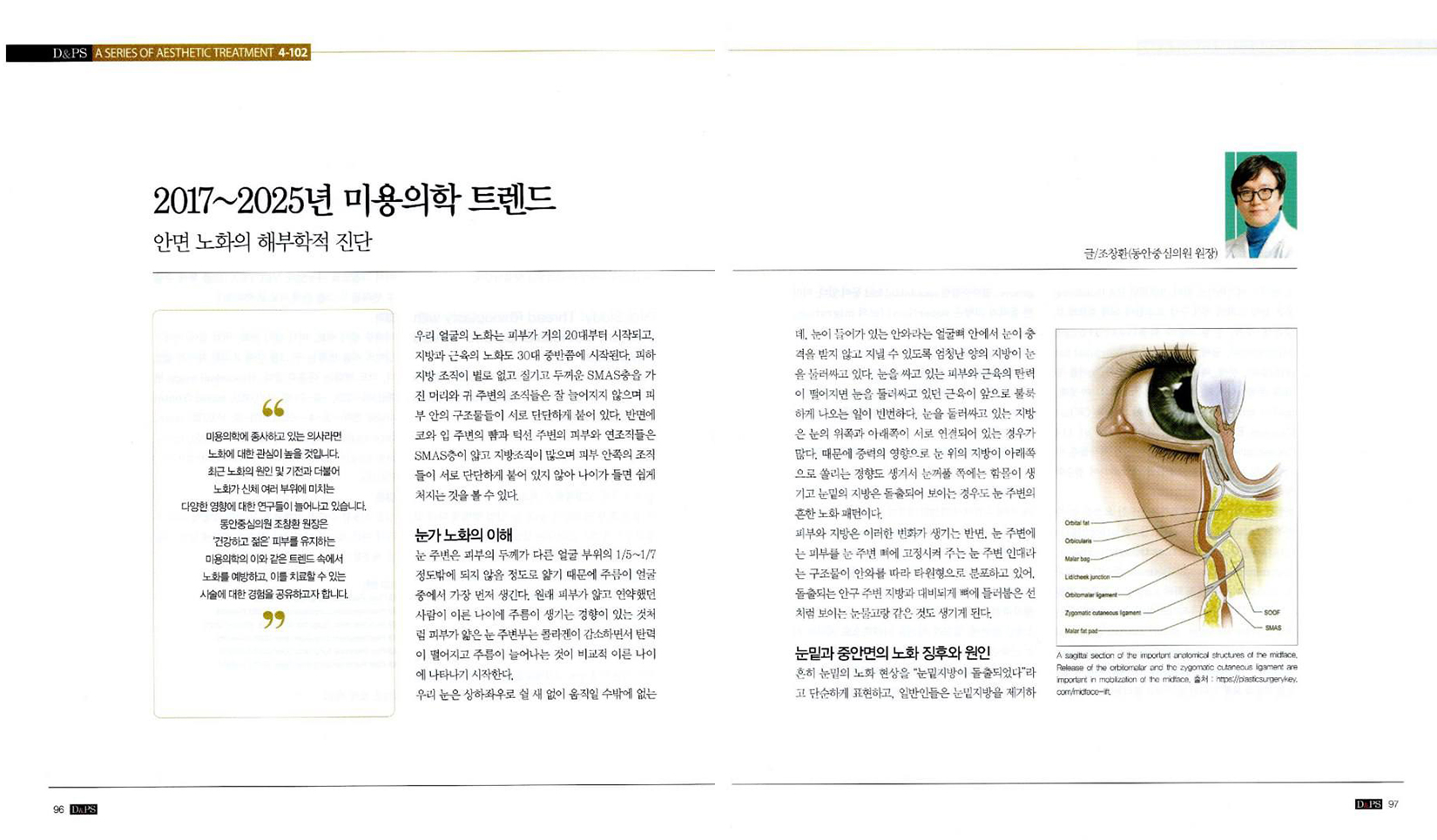
Dr. Chang-hwan Cho of Dong-An Joongsim Clinic contributed a column to the July 2025 issue of D&PS magazine titled “2017–2025 Aesthetic Medicine Trends: Anatomical
Analysis of Facial Aging.”
-Column Content-
Facial aging begins gradually in the late 20s and becomes more pronounced after the mid-30s. The dermis thins, fat is redistributed, and muscles and ligaments relax,
weakening the structural support of the face. The SMAS layer and retaining ligaments loosen, causing fat to migrate downward, which leads to increased sagging and
wrinkle formation. The periorbital area is especially prone to aging because of its thin and delicate skin, making it susceptible to wrinkles, hollowing,
and fat protrusion. Typical changes include eyelid wrinkles, lower eyelid fat bulging (commonly described as “under-eye bags”), and the formation of the tear trough.
As fat descends and muscles weaken around the eyes, the overall expression appears tired and aged. Loosening of ligamentous support in this area also contributes to
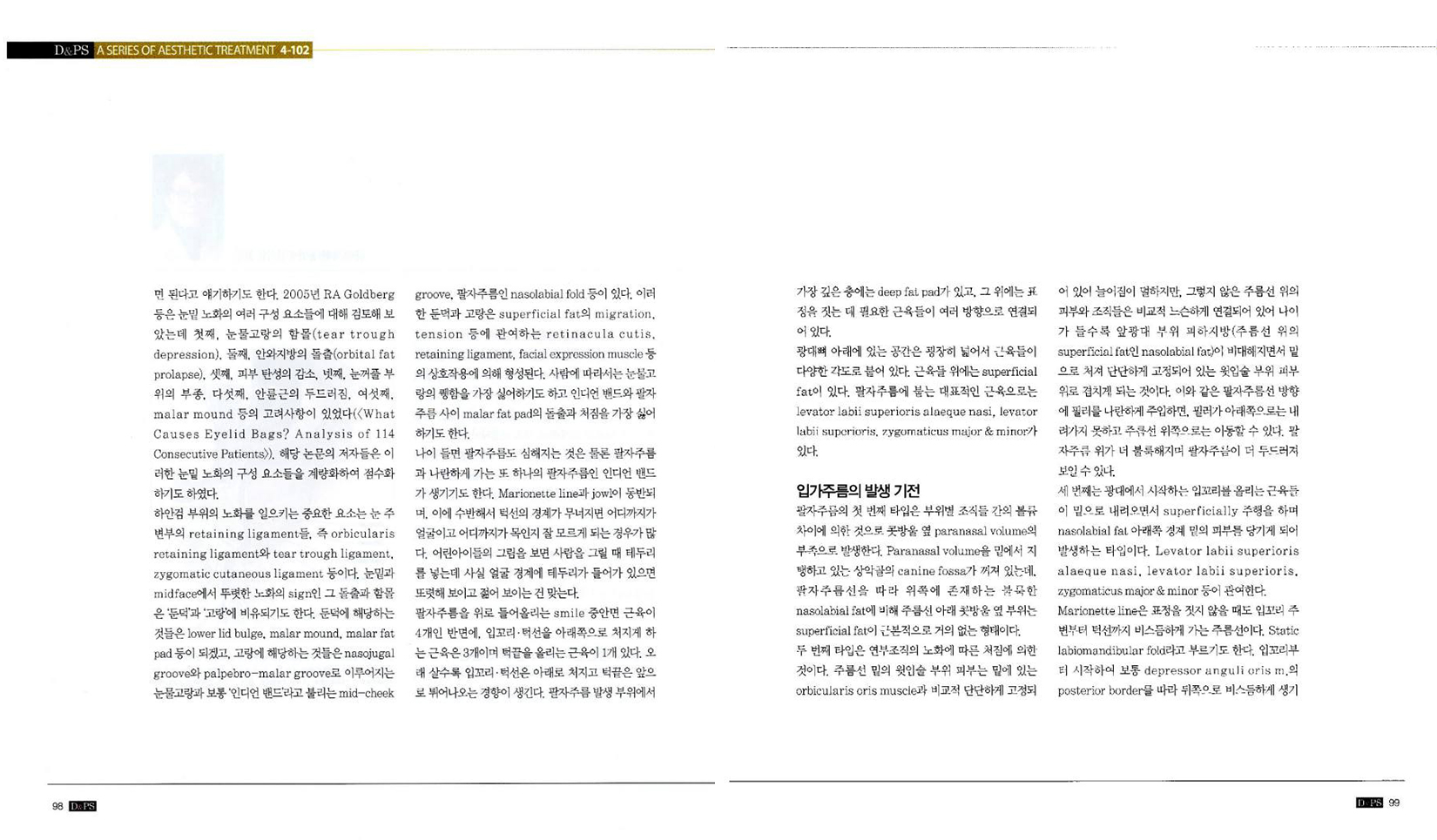
fat redistribution, altering midface volume and creating deep grooves. Perioral wrinkles develop through two main mechanisms. First, reduction in paranasal volume
deepens the nasolabial fold. Second, structural changes around the orbicularis oris muscle create fixed, deeply etched lines. The superficial fat overlying the
nasolabial fold becomes thinner, and fixed creases form, with close involvement of muscles such as the levator labii superioris and the zygomaticus major and
minor. The marionette lines (sagging lines at the corners of the mouth) result from downward fat migration and ligament weakening beneath the mouth.
Changes in the position of the modiolus (the fibromuscular node at the mouth corner) also accentuate these lines. East Asian populations, including Koreans,
often have a more inferiorly positioned modiolus, making lower-face sagging and marionette line formation more prominent. The commissural line (the crease at
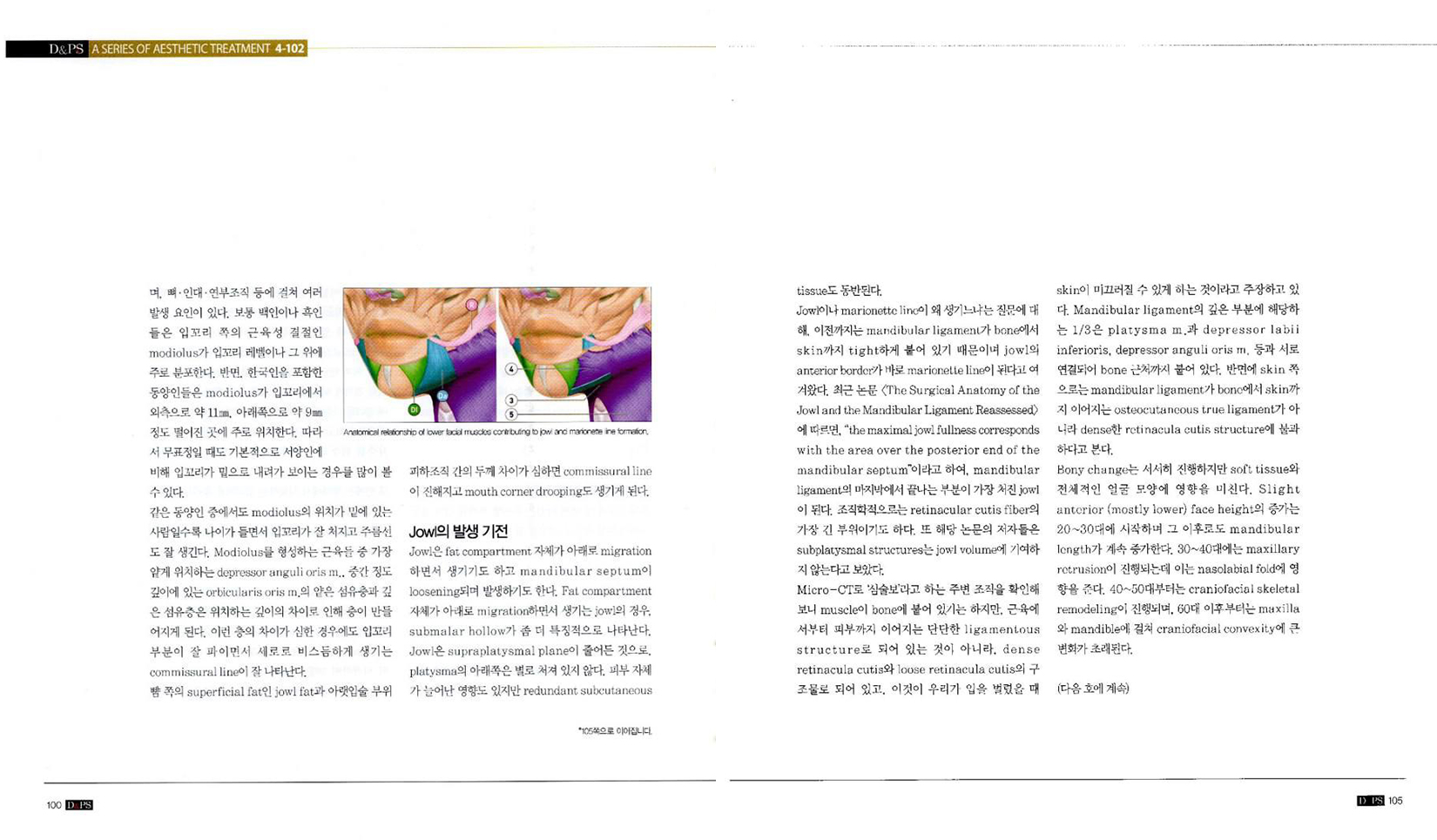
the mouth corner) also deepens due to weakening of subcutaneous fat and supporting ligaments. Jowl formation occurs as fat compartments migrate downward and
the mandibular septum loosens. The platysma muscle and other soft tissues weaken, causing skin to sag and fat to accumulate lower on the face. Weakening of the
mandibular ligament is a key factor, and midface retaining ligament laxity is closely linked to jowl development. Additionally, bony changes with age alter
the lower facial skeleton, accelerating sagging in the lower face. Ultimately, facial aging is a complex process involving simultaneous changes in the skin,
fat, muscle, ligaments, and bone. Treatment must go beyond simply adding volume to focus on restoring and maintaining anatomical support. Managing not only
fat volume but also fat quality an approach sometimes called “Facial Fat Fitness” is essential. A deep anatomical understanding of ligaments, fat pads,
and muscles is critical to devising individualized treatment plans. Modern aesthetic medicine is evolving from simply “filling” the face to a precise science of
restoring anatomical harmony and youthful movement.